


Description
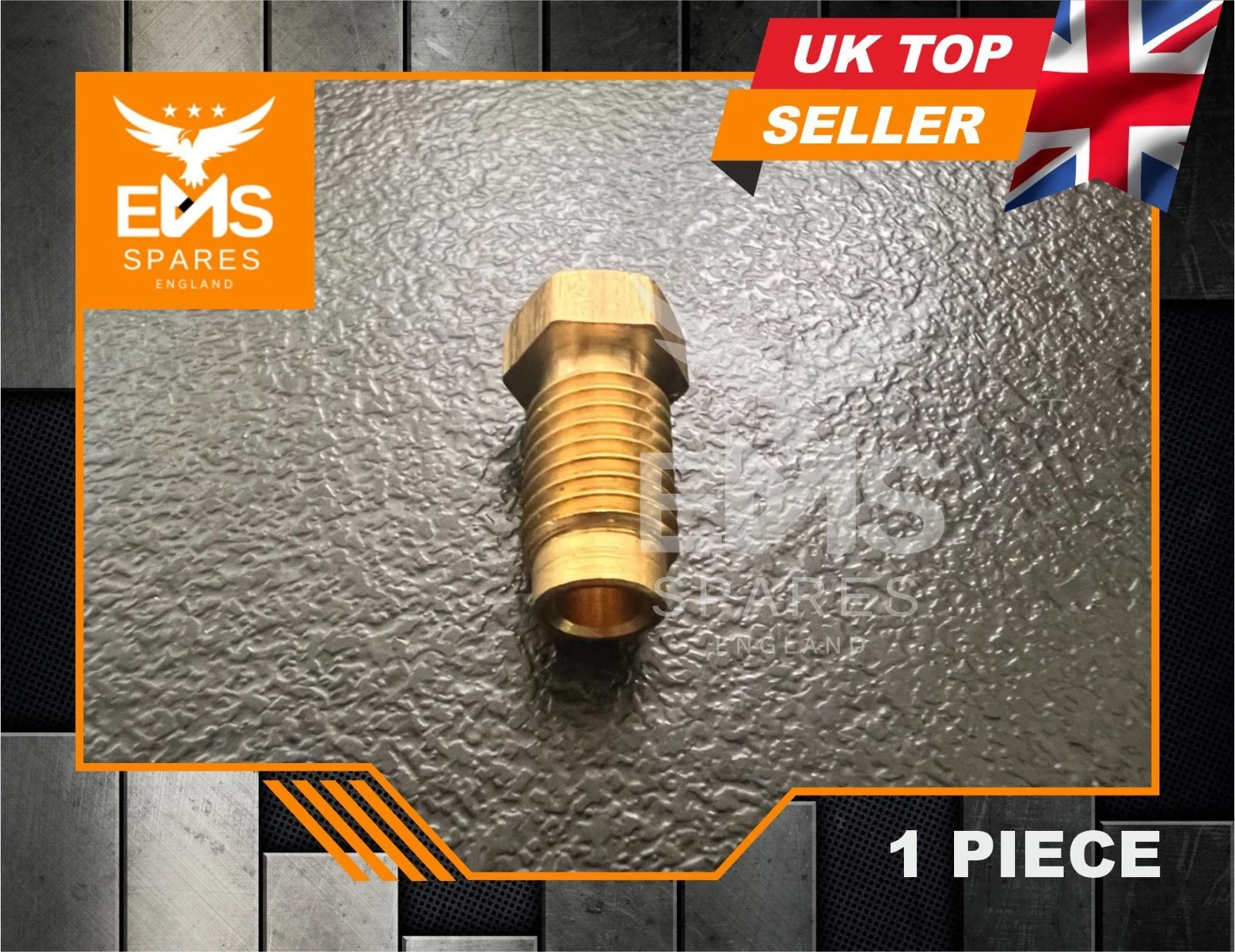
Brass Brake Pipe Union 3/8″ UNF x 24 Male (Long) for 3/16″ Pipe
Solid brass male brake pipe union (also called a male tube nut or brake pipe nut) with a 3/8″ x 24 UNF thread, made for 3/16″ (4.75mm) brake and clutch pipe. This is the long version with a pilot lead – the most common imperial brake union on classic British cars, kit cars and older vehicles. Supplied by EMS Spares, Leicester – over 30 years in automotive components.
Specification
| Thread | 3/8″ x 24 UNF (24 threads per inch) |
|---|---|
| Pipe size | 3/16″ (4.75mm) brake / clutch pipe |
| Type | Male union, long, with pilot lead |
| Overall length | 21mm approx |
| Thread length | 17mm approx |
| Material / finish | Solid brass, natural finish – rust resistant, will not seize |
| Interchange reference | HU1* |
| EMS part number | EMS-A1 |
* Reference numbers are for identification only. All dimensions are approximate.
Buyer’s guide: brake pipe unions explained
What does a brake pipe union do?
A brake pipe union is the threaded nut that holds a flared brake pipe tight against a component – master cylinder, wheel cylinder, caliper, brake hose, T-piece or pressure valve. The union itself does not seal; it clamps the flare on the end of the pipe into the seat of the port, and that metal-to-metal contact makes the seal. That is why the union thread and the flare type must both match the component.
Step 1 – identify your thread (the most common mistake)
| Thread | Outside diameter | Threads | Typically found on |
|---|---|---|---|
| 3/8″ x 24 UNF (this part) | 9.5mm approx | 24 per inch | Most British classics: MG, Triumph, Mini, Austin, Morris, Land Rover Series, Jaguar, kit cars |
| 3/8″ x 20 BSF | 9.5mm approx | 20 per inch | Older British cars (often pre-1960s) |
| M10 x 1mm | 10mm approx | 1mm pitch (about 25 per inch) | Most European and later cars |
Tip: 3/8″ UNF and M10 x 1 look almost the same and will start to screw in, then bind. Never force a union – forcing the wrong thread damages the port. Measure the outside diameter (9.5mm = 3/8″, 10mm = M10) or use a thread gauge, or compare against your old union.
Step 2 – male or female?
- Male union (this part): thread on the outside – screws into a threaded hole (master cylinder, wheel cylinder, T-piece, 4-way union).
- Female union: thread on the inside – screws onto a male port, such as many flexible brake hoses.
Step 3 – long or short?
This is the long union with a pilot lead (a plain section at the front). The lead guides the union in straight and supports the pipe, which helps prevent cross-threading. If the port is shallow, choose the short / no-lead version instead.
Step 4 – flare type: single or double, SAE or DIN?
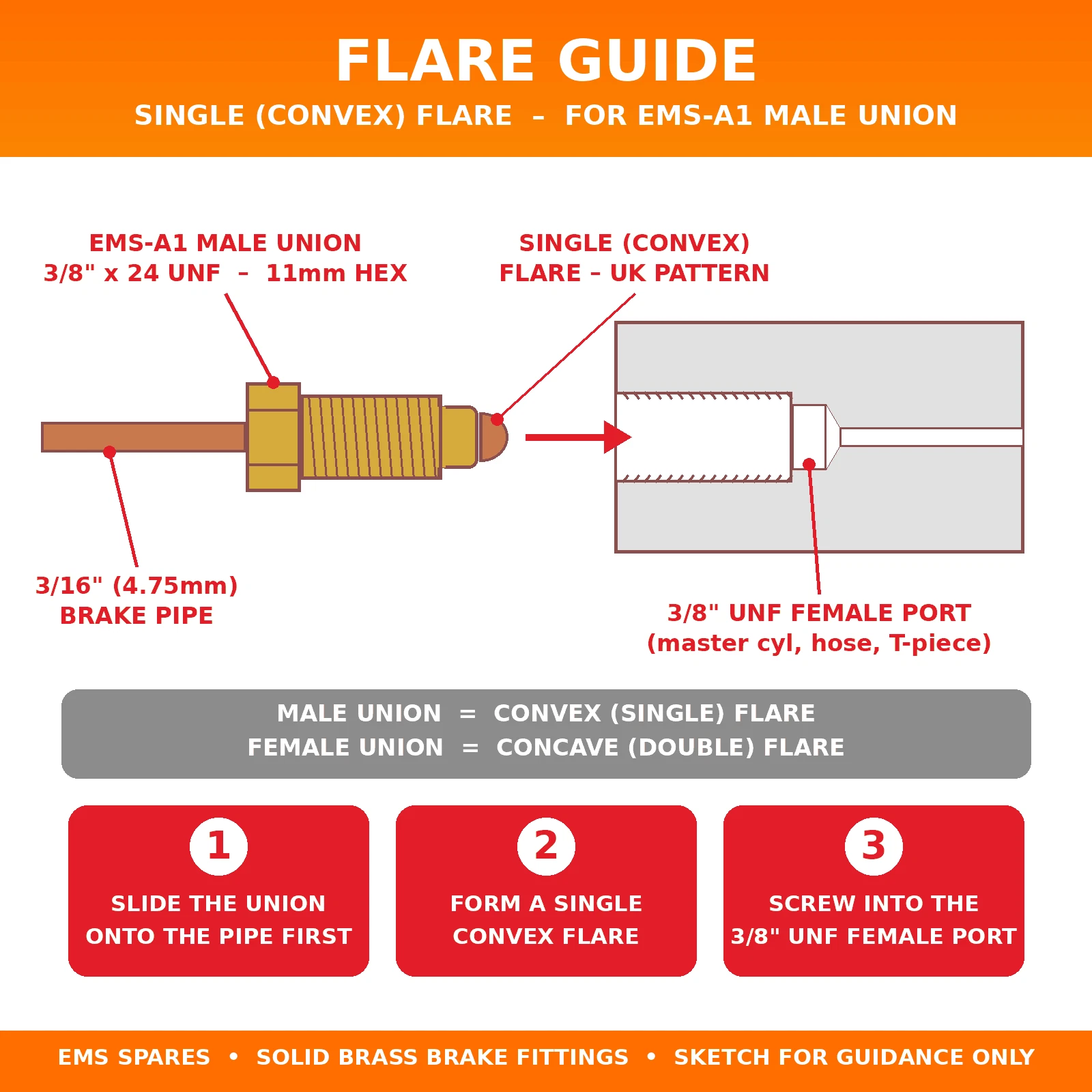
This union is made for a single (convex) flare – the standard UK pattern used on British classic cars with 3/8″ UNF fittings. Always match the flare on your old pipe and the seat in your component:
- Single (convex) flare – UK pattern: the pipe end is formed into a rounded “bubble” that seats into the port. Use this union.
- Double / inverted flare (American SAE 45 degree): used on many US vehicles and some later cars. Different shape – not for this union.
- Metric (DIN / ISO) fittings: normally M10 x 1 thread – choose our metric unions instead.
Not sure? Send us a photo of your old pipe end and we will tell you which flare and union you need.
Step 5 – pipe size and material
This union is for 3/16″ (4.75mm) outside-diameter pipe, the standard UK car brake pipe size. It suits copper-nickel (Kunifer), copper and steel brake pipe. For 1/4″ pipe choose the matching 1/4″ union.
How to fit – good practice
- Slide the union onto the pipe the right way round before you make the flare.
- Make a single (convex) UK pattern flare with a proper flaring tool. Check it is even, central and free from cracks.
- Start the union by hand for several turns – it should turn freely. If it binds, stop and check the thread.
- Tighten with an 11mm split (flare nut) spanner, not an open-ended spanner, so the brass hex is not rounded. Brass is softer than steel – firm, not excessive.
- Bleed the brakes, then check every joint for leaks with the pedal pressed hard.
Safety: brakes are a safety-critical system. If you are not confident, have the work done or checked by a qualified mechanic.
Fits many classic cars
With imperial 3/8″ UNF brake fittings, including:
- Austin-Healey: 3000 (1960-68), Sprite (1960-71)
- Daimler: 2.8 – 5.3 (1969-93), Coupe (1973-77), Dart (1959-64), Landaulette (1974-91), Limousine (1968-91), V8 (1967-70), XJ / XJ40 (1986-2003)
- Ford: Capri (1968-77), Consul (1972-75), Corsair (1963-71), Cortina inc. Estate (1962-79), Escort inc. Estate (1968-81), Taunus / 12M / 15M (1951-79), Transit (1955-78), Zephyr & Zodiac (1962-72)
- Jaguar: MK X (1961-70)
- Land Rover: Series II (1958-61)
- Morris: Mini (1976-81), Oxford (1959-70)
- Triumph: 1300, 1500, Acclaim, Dolomite, GT6, Italia, Spitfire, Stag, Toledo, Vitesse, TR2, TR3, TR3A, TR4, TR4A, TR5, TR6, TR8 (1953-85)
…and many other classic British and European vehicles with imperial UNF brake fittings. Please check your existing fitting before ordering.
Pack sizes
Available as 1, 3, 5, 10 or 20 unions. Larger packs cost less per union – a full brake pipe re-build on a typical classic car uses 8-12 unions.
Delivery
Free UK delivery on every order (including Northern Ireland, Highlands & Islands). Same-day dispatch on orders placed before 10am.
Trusted by thousands of buyers on eBay
99.9% positive feedback from over 9,700 ratings, and 5.0 out of 5 for accurate description, postage cost, delivery time and communication (last 12 months). Read our eBay feedback.
FAQ
Will this fit copper (Kunifer) pipe? Yes – any 3/16″ (4.75mm) brake pipe: copper-nickel, copper or steel.
Is 3/8″ UNF the same as 3/8″ BSF? No. Same diameter, but BSF has 20 threads per inch and UNF has 24. They are not interchangeable.
Can I use this on the clutch pipe? Yes, where the clutch master or slave cylinder uses a 3/8″ UNF port and 3/16″ pipe.
Why brass and not steel? Brass does not rust or seize in the port, so the union can be undone again years later without snapping the pipe.
Which spanner do I need? An 11mm split (flare nut) spanner fits the hex.
Is it single or double flare? Single (convex) flare – the UK pattern used on British classic cars.
Need help? Message us with your vehicle and the part you are connecting to and we will confirm the right union before you order.

Reviews
There are no reviews yet.